 HOST
Singapore
LOCATION
21
ATTENDEES
Finance & IT
INDUSTRY
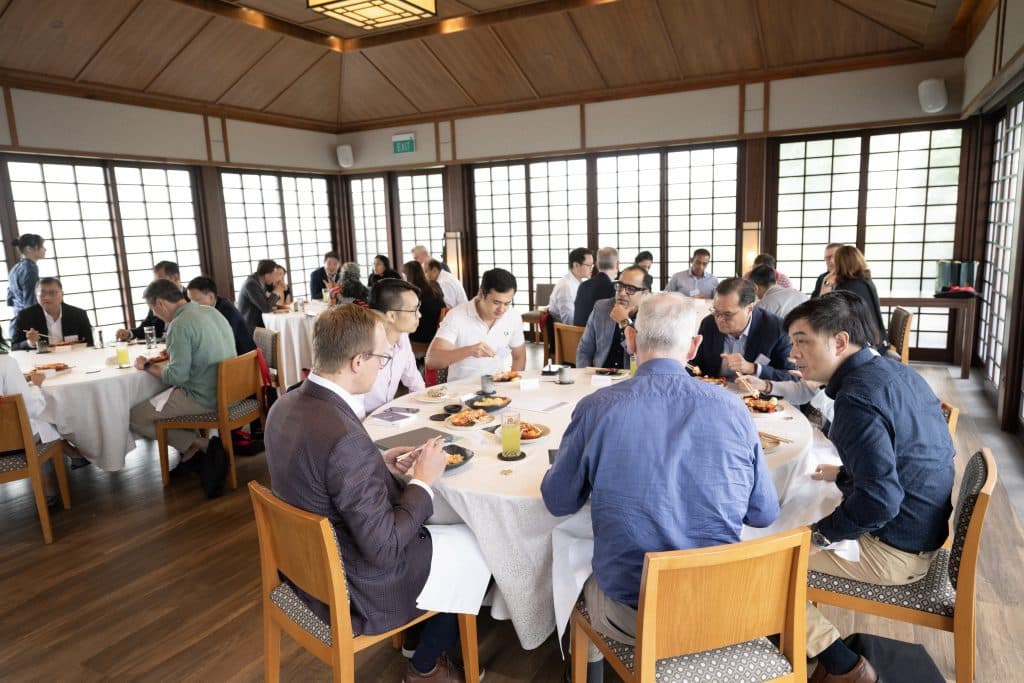
SINGAPORE, NOVEMBER 19, 2024 — Twenty-one CFOs and finance chiefs gathered at Keyaki in Marina Square for a masterclass luncheon hosted by Red Hat, tackling the question every finance leader is now being asked to answer: how to steer AI-driven transformation without losing control of risk, governance, and trust.
THE BRIEF
Charting a Course for Finance in the Age of AI
Red Hat partnered with The Ortus Club to bring Singapore’s finance leadership into one room at a moment when AI has moved from a talking point to a line item. The brief was straightforward but far from simple: create a closed-door setting where CFOs could speak candidly about where AI is actually changing their function, rather than where the marketing decks say it should.
The masterclass luncheon format was designed to get straight to the point. No keynote-and-Q&A distance, no product pitch. Instead, a short framing discussion followed by a panel and table conversation, giving finance leaders room to compare notes on governance, automation, and where the real cost savings are versus where they’re still promised.
THE SETTING
A Private Room Above Marina Bay
The event with Red Hat was held at Keyaki, the Japanese restaurant inside the Pan Pacific on Marina Square — a venue The Ortus Club has long relied on for the quality of its private dining rooms and the discretion of its service. Guests arrived from 11:30 am for a lunchtime session built around focus rather than spectacle: a closed room, a seated format, and a menu designed to keep the conversation moving rather than compete with it.
Interested to find out how the event was shaped and the work that went behind it?
THE GUESTLIST
A Room of Finance Leaders
Of the twenty-one finance leaders in attendance, the majority held the CFO title outright, with several regional and group-level finance and audit heads rounding out the table. The industries represented ranged from fintech and telecommunications to industrial manufacturing and private equity — a spread that gave the AI conversation more texture than a single-sector room would have allowed.
Companies represented included:
- YouTrip, IBM, F5 Networks, Aspire, MatchMovePay
- Olam Ventures, Tyroo, Bromat Holdings, Twenty20 Energy
- ComfortDelGro, SingTel, Telstra, Standard Chartered, NTT
- Bandai Namco, Siemens Healthineers, Peak XV Partners, Milestone Systems, EM Services, Wellesta Holdings, Tamco Switchgear
That mix of listed multinationals, high-growth fintechs, and industrial operators meant the discussion moved fluidly between boardroom-level governance concerns and the practical mechanics of deploying AI inside a finance team.
THE TOPIC
Reimagine Finance. Redefine Risk.
The central question on the table with Red Hat was how CFOs steer their organisations through AI-driven transformation without losing their grip on governance. AI offers genuine upside for finance — sharper forecasting, faster close cycles, better fraud detection — but it also introduces new categories of risk that most finance functions were not built to manage.
Subtopics explored included:
- Using AI for risk management, fraud detection, and ESG integration
- Building governance and ethical standards around AI adoption
- Automating workflows to cut costs and reduce manual error
- Using AI analytics to sharpen and speed up strategic decision-making
THE INSIGHTS
Where Automation Ends and Judgement Begins
These are the key insights from the discussions with Red Hat.
AI is being adopted fastest where the stakes are lowest. Several CFOs in the room pointed out that automation is landing first in reconciliation, reporting, and fraud flagging — tasks with clear rules and low political risk — while forecasting and strategic scenario planning remain stubbornly human. The gap between where AI is deployed and where it’s trusted was a recurring theme.
Governance is now a finance problem, not just a compliance one. With AI tools increasingly embedded in day-to-day financial workflows, several finance chiefs argued that the CFO — not just the risk or compliance function — has to own the governance conversation, because the financial consequences of a bad AI-driven decision land squarely on their desk.
The cost-saving narrative is running ahead of the evidence. Not everyone in the room was convinced by the efficiency pitch. Some pushed back on the assumption that AI automatically translates into headcount or cost reduction, noting that the implementation and oversight burden often eats into the promised savings, at least in the short term.
Trust is the actual bottleneck, not technology. More than one participant noted that the technical capability of AI tools has outpaced the finance team’s ability to explain, audit, and stand behind AI-generated numbers — meaning the limiting factor on adoption isn’t what the tools can do, but how confidently a CFO can defend them to the board.
KEY TAKEAWAYS
Lessons in Governance, Efficiency, and Trust
Let’s go over the key takeaways from the discussions with Red Hat.
- Start with low-risk automation. Reconciliation, reporting, and fraud detection are the safest entry points for AI in finance.
- Governance can’t be outsourced. CFOs need to own AI oversight directly, not delegate it entirely to risk or IT.
- Efficiency gains take longer than promised. Budget for an implementation and oversight period before expecting cost savings.
- Explainability is the real constraint. The ability to defend AI-driven numbers to a board matters more than the sophistication of the model.
- ESG and AI are converging. Several finance leaders are already using AI tools to strengthen ESG reporting and integration.
THE RESULTS
A Focused Room, A Sharper Conversation
- 21 finance leaders in attendance, predominantly CFO and C-suite level
- 1 masterclass luncheon session, delivered in a closed-door format
- Companies spanning fintech, telecom, industrial, and private equity sectors
The luncheon delivered exactly what Red Hat set out to create: a room of finance decision-makers engaging directly with the operational realities of AI adoption, rather than its marketing promises. The candour of the table discussion — including genuine disagreement over how fast cost savings should be expected to materialise — is the kind of signal that’s difficult to generate in a larger or less curated setting.
For Red Hat, the event reinforced its standing among Singapore’s finance community as a credible voice in the AI governance conversation, not just a technology vendor. For The Ortus Club, it reaffirmed what a tightly run, senior-only masterclass can do when the guest list, agenda, and format are built around genuine peer exchange rather than a sales agenda.
Request a Feasibility Study
Our Feasibility Studies show exactly who we can reach and how we can engage them. Using your brief, we analyse roles, regions, industries, and company size to deliver a clear, data-driven report that highlights your audience potential.