
Stephan Schmitt’s career spans 25 years of technology leadership. It began in IT operations, where he led a managed service capability for middleware and database services in EMEA and built a team of database administrators across seven countries and 17 locations. He then moved into a European function working with global system integrators and service providers, before taking on digital transformation and consulting roles, including building a centre of expertise in Cambridge, UK, with a focus on healthcare and life science customers.
Three years ago, he started his own business, Tech Advisory, which supports customers on their digital journey, go-to-market and the building of digital products and solutions. He also works as a faculty lecturer at the CTO Academy. Based in Frankfurt, Stephan has become one of The Ortus Club’s veteran moderators. His approach is shaped by a consultant’s habit of giving answers and a moderator’s discipline of not doing so. The one question he says he will never stop asking is simply “why?”: why things are as they are, and why we are not changing.
How did a career in technology leadership lead to moderation?
Stephan Schmitt explains how years of leading conversations with senior stakeholders turned into a moderating practice, and recalls his first guided conversation during a sensitive outsourcing transition.
“I did not start as a professional moderator. My background is in 25 years of technology leadership. In that role, I was building and leading conversations, and I moved into facilitating meetings and leading discussions. I spent a lot of time with C-level customers, cross-functional teams, partners and complex stakeholder groups.
Whether it was steering architectural reviews, guiding digital transformation workshops or running executive roundtables, I realised that the real value often comes from creating space for open peer-to-peer exchange rather than presenting slides.
My first moderated conversation was a complex situation with a customer who had just moved to an outsourcing agreement. The process covered the current mode of operation, the transition mode and the future mode, and the customer was very sensitive to the change happening over the next few years. A trusted conversation, leading to a trusted relationship over the long term, was the starting point.
It was less about explaining what would happen to his IT landscape and more about giving both teams, mine as the future provider and his as the current delivery team, a good feeling about how to transfer knowledge and experience without hurting the quality of his business.”
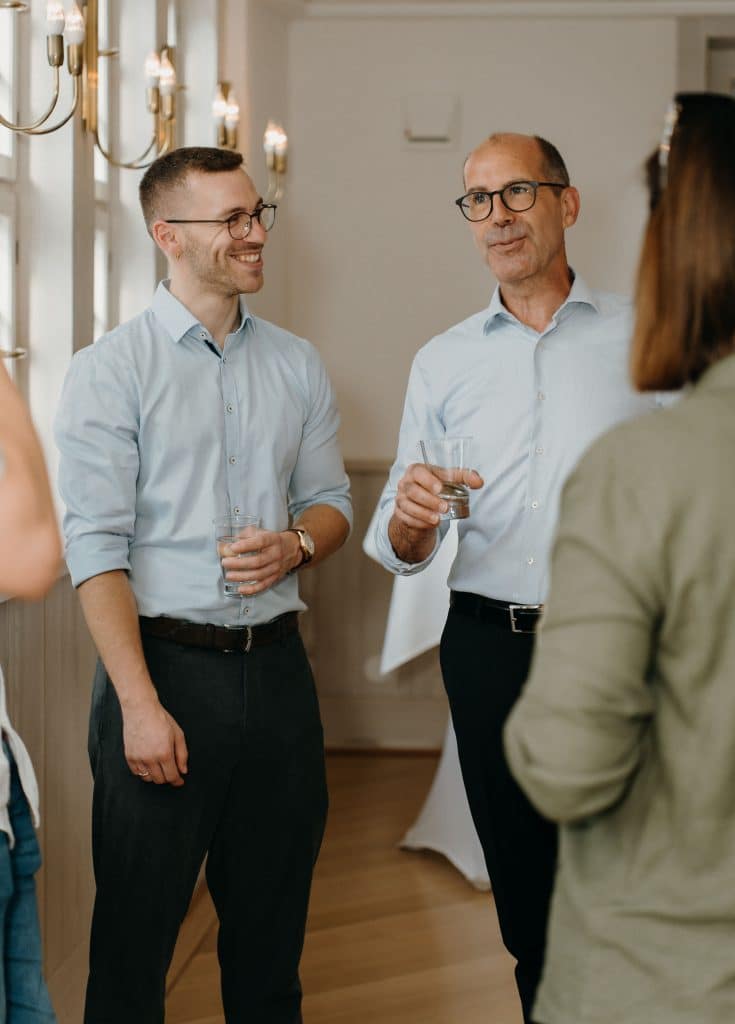
How do you prepare for, and lead, an unscripted conversation?
Stephan Schmitt describes a structured approach to preparation, the two parallel processes he runs during an evening, and the bold statements he keeps in reserve.
“In that first session, you could not really prepare, because you did not know what was coming. For moderated sessions today, especially the ones with The Ortus Club, I work in three steps. The first is understanding the audience, which I think is the most important. The second is structuring the flow, because you know the topic and you know the people. The third is defining principles.
With an unscripted event, you are running two processes in parallel. You prepare maybe one, two or three questions, which are the red line through the evening, and you really need to listen to the responses during the introduction and the first question. The second process is noting down those responses, because during the entire evening you can hook back into them and say, ‘You mentioned this in the first question. How does it relate to this point in the discussion?’ You can phrase a new question out of that and keep the ball rolling. You need two CPUs and two different threads, always listening between the lines and knowing the direction the conversation should take, so that it does not drift too far from the goal of the evening.
If the conversation stops or fades, I have one or two bold statements on the back burner. They may be a bit provocative, but people find them an interesting point to disagree with. It is easy to disagree, and it gives the conversation new flow, maybe in a completely different direction. Two is enough for a two-hour conversation.”
What has moderating taught you about senior leaders?
Stephan Schmitt reflects on how rarely leaders share failures, and why cross-industry conversation is where much of the value lies.
“What surprises me is when someone says, ‘We tried that, and we failed, and the failure was because of this.’ Most conversations move towards everybody wanting to share positive projects or business success, but that is not where the rest of the audience can learn. It is easier to learn from mistakes or things that failed. If somebody has the openness, or finds the trust in the room, to share a failure, I find that very surprising, because it is not very common in our society.
You go out at the end of the evening thinking, ‘I have seen another five pretty projects, but what does it give me?’ The outcome is much better if people share a problem they faced, where they failed and why. That gives people an idea of what to avoid, what to put additional attention on, or topics nobody had thought about.
People come from different industries to these events. Somebody in banking or finance thinks the problem they face is very unique to their industry, but it is not. Healthcare, which is highly regulated, faces the same issues as public services or finance. If you step back and show people they are not alone, they can lean into another industry’s experience. That is where the benefits come from, because everybody keeps reinventing the wheel without access to industries where the problem may already be fixed.”
How is moderating different from consulting?
Stephan Schmitt explains the discipline of stepping back, what still makes him nervous, and how he hopes his style will evolve.
“There is no big change in how I show up. The difference is that you leave the answer to the room, whereas in consulting you have to give the answer yourself. In moderated sessions, I do not advise people on the result or on what they should do. I use my experience, more than my skills, to give direction to the conversation, but I leave it to the audience to answer.
Sometimes you think, ‘I would give that answer now. This is the roadmap.’ But you do not give the answer. You let the audience get to it, and perhaps push in a direction a little. Sometimes it comes in a completely different way, and you think, smart people in the room, of course, have different answers that I would not have. I am not the smartest person in the room that evening.
I still get a bit nervous if I moderate a topic where I have only basic knowledge and people show up who are deeply into it. You need to be one page ahead in the book, but not more than that.
Today, my moderations are a little planned and structured, which is the way I get into them, with the three steps I mentioned. In five years, I hope to be more professional and more spontaneous, so that a quick look at the titles and the people attending would be enough to take the lead without the structure and plan in place, just knowing what to do to stimulate the next 10 to 15 minutes.”
What advice would you give to someone starting out as a moderator?
Stephan Schmitt encourages leaders to try moderation and shares the practical habits that have worked best for him.
“Moderating a session is a very exciting experience, and I did not know what I had missed before I did it for the first time. It gives you a lot of additional skills for your own career, so I would motivate everybody to start, or at least try, moderation.
Preparation is important, but that is not something new. My advice is to protect the environment. In executive settings, the biggest value often comes from psychological safety, and explicitly setting a pitch-free tone at the beginning helps a lot. Listen to the reaction in the room, and to the body language.
Keep your ears and eyes open to respond to what you see, and lean into what has been said, because that is the question for the next five minutes. Keep transitions clean and short. A good transition helps the group feel guided without feeling controlled.”
Join the Conversation: The Ortus Club’s Executive Network
As Stephan Schmitt has shown, the best executive conversations are not presentations. They depend on open peer-to-peer exchange, on trust in the room, and on leaders willing to share what did not work as well as what did.
His observation that people often live in their own bubble, repeating the same problems with the same peers, points to why cross-industry dialogue matters. Leaders benefit from stepping outside their own sector to see that their challenges are shared, and that someone else may already have found a way through.
At The Ortus Club, we host curated executive roundtables that bring senior leaders together for exactly these kinds of unscripted, pitch-free conversations. Join our network to exchange honest insights with peers across industries.
FAQs Section
Q: How should a moderator prepare for an unscripted roundtable?
A: Stephan Schmitt works in three steps: understanding the audience, structuring the flow and defining principles. He prepares a handful of questions as the red line through the evening and keeps one or two bold statements in reserve.
Q: What is the biggest difference between moderating and consulting?
A: In consulting, you give the answer yourself. In moderating, you leave the answer to the room and use your experience to guide the conversation. Stephan describes stepping back from the consulting approach as maybe the hardest part.
Q: How do you revive a conversation that is fading?
A: Stephan keeps one or two bold statements on the back burner. They may be a little provocative, but they give people something to disagree with, which can bring new flow and a new direction. Two is enough for a two-hour conversation.
Q: Why does psychological safety matter in executive roundtables?
A: In executive settings, the biggest value often comes from psychological safety. Explicitly setting a pitch-free tone at the beginning helps leaders feel able to share openly, including what has not worked.
Q: Why is cross-industry dialogue valuable for senior leaders?
A: Problems that seem unique to one industry are often shared by others. Healthcare, public services and finance, for example, can face the same issues, and leaders can apply principles that have already been used elsewhere rather than reinventing the wheel.


